What to expect
The dental implant process, stage by stage
Implant treatment is a sequence spread over months, not a single appointment. Knowing the shape of it in advance makes the whole thing considerably less daunting.
What to expect
The path from first visit to final restoration
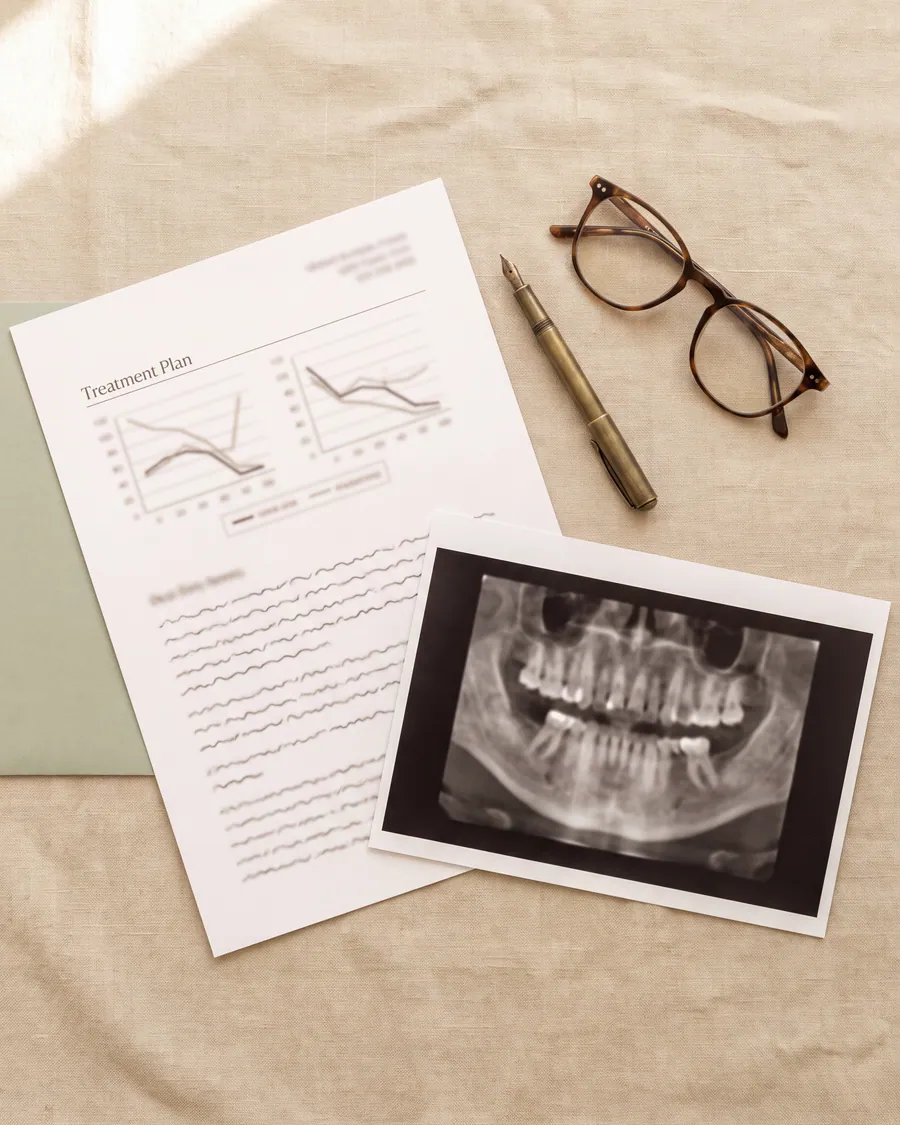
- 01
Consultation and evaluation
You describe what is bothering you and what you would like to be able to do. The dentist examines your mouth, reviews your medical history and discusses whether implants are a reasonable option for you.
- 02
Imaging and personalized planning
Three-dimensional imaging shows bone volume, nerve position and sinus anatomy. The dentist uses it to plan where an implant could be placed and what restoration it would carry.
Imaging may be arranged at the first visit or at a separate appointment.
- 03
Preparation, when it is needed
Some cases need a tooth removed, a site grafted, or gum health addressed before an implant can be placed. Not everyone needs this step.
Where preparation is required, healing time is added before placement.
- 04
Implant placement
The implant is placed into the jawbone, usually under local anesthesia. Aftercare instructions cover what to eat, how to clean the area and what discomfort to expect.
- 05
Healing and integration
The bone gradually forms a connection with the implant surface. A temporary restoration may be worn during this period so you are not left with a visible gap.
This phase is measured in months, and its length varies from person to person.
- 06
The final restoration
Once the implant is stable, impressions or scans are taken and the final crown, bridge or denture attachment is fitted and adjusted to your bite.
Timelines vary considerably. Some people move through these steps over a few months; others need preparatory treatment first, which extends the schedule. Your dentist can give you a realistic timeline once your imaging has been reviewed.
Recovery, honestly
Recovery from implant placement is usually more manageable than people expect, but it is surgery and it is not nothing. Here is a realistic picture.
- The first 48 hours
- Swelling and soreness are usual and typically peak around the second day. Your dentist will give specific instructions on what to eat, how to clean the area, and what pain relief is appropriate for you.
- The first week
- Most people return to normal activity quickly, keeping to softer foods and avoiding chewing directly on the site. Any stitches are usually reviewed or removed during this period.
- The healing months
- The implant integrates with the bone. There is generally little to feel during this phase. A temporary restoration may be worn so there is no visible gap.
- After the final restoration
- Normal brushing and flossing, with any specific cleaning aids your dentist recommends, plus routine professional maintenance. Report anything that feels loose or uncomfortable rather than waiting.
Why healing time is not negotiable
The waiting period exists because bone remodelling takes the time it takes. Loading an implant before it has integrated risks losing it, which is why a dentist who declines to rush this stage is protecting your investment rather than being unhelpful.
Some cases allow a temporary restoration to be fitted sooner. Whether yours is one of them depends on how stable the implant is at placement, which is assessed at the time.
What can extend a timeline
Extraction that needs the socket to heal before placement, bone or soft-tissue grafting, treating gum disease first, or a sinus procedure in the upper jaw. None of these are complications — they are planned steps that some cases need and others do not.
Common questions
Questions about treatment and recovery
How long does the process take?
Timelines vary widely. A straightforward single implant with healthy surrounding bone may move from placement to final restoration over a period of several months, because the implant needs time to integrate with the bone before the final crown is attached.
Cases that involve extraction, grafting or several teeth can take longer. Your dentist can give you a realistic schedule for your specific situation once imaging and an examination are complete.
Is implant placement uncomfortable?
Implant placement is usually performed with local anesthesia so the area is numb during the procedure. Many patients describe the appointment itself as more manageable than they expected.
Some soreness, swelling or bruising afterwards is common, and your dentist will discuss what to expect and how discomfort is typically managed. Individual experiences differ, and no dental procedure can be described as free of discomfort for every patient. If anxiety is a concern for you, raise it at the consultation — sedation options may be available.
What if I have been told I do not have enough bone?
Bone can shrink in an area where a tooth has been missing for a long time, and that finding is common. It does not automatically rule out an implant.
Depending on how much bone is available and where, a dentist may discuss procedures that build up or preserve bone, implant positions that use the bone you do have, or alternatives to implants. A 3D scan gives a far more precise picture than a standard x-ray, so a second evaluation is often worthwhile if your previous assessment did not include one.
What happens during the consultation?
A consultation is a conversation and an examination, not a commitment. Expect the dentist to ask what is bothering you and what you would like to be able to do, examine your mouth, and review imaging to assess bone and surrounding structures.
From there you should receive an explanation of the options that apply to you, what each would involve, roughly how long it would take, and what it would cost. You are free to take that information away and think about it.
When you are ready
Take the next small step.
A consultation is a conversation about what is possible — not a commitment to treatment. You will leave knowing your options, what each would involve, and what it would cost.
Prefer to talk it through first? Call Laguna Niguel Dental on (949) 363-2010.
Independent advertising website. Requests go to Laguna Niguel Dental, a participating provider. Learn more.